Trade Strategy Guide: Winning Negotiations Against an AI That Fights Back
Learn how to win trades in Basketball Dynasty, where the AI counters offers like a real front office. Asset value, timing, counter-offers, and the trades to never make.
Updated
Play freeMost basketball management games have a trade menu. Basketball Dynasty has a trade negotiation — the AI values its players honestly, protects its stars, respects its own timeline, and answers a bad offer with a counter-offer instead of a flat no. This guide covers how value actually works, when to trade, and the patterns that separate GMs who accumulate assets from GMs who accumulate regret.
How the AI thinks
Every AI front office evaluates a trade through its own situation, not yours. A rebuilding team prices veterans low and picks high; a contender does the opposite. The same player is worth different amounts to different teams on the same day — and finding the team that values your asset most is the entire skill.
When the AI counters, it's showing you its hand. A counter that strips out your young player and adds your pick tells you exactly what that front office is building around. Treat every counter-offer as free scouting on a rival's strategy.
The four currencies of trade value
- Stars. The scarcest asset. Two good players never equal one great one, because you can only play five at a time and great players decide playoff games. If you have the chance to consolidate into a star without gutting your depth entirely, take it.
- Young players on cheap deals. The engine of every rebuild. Their value is part production, part contract — a solid starter making little money is a tradeable surplus everywhere.
- Draft picks. Pure optionality. Picks are most valuable in the hands of teams that don't need them now, which is why contenders pay heavily for them at the wrong time. Sell picks when you're contending; hoard them when you're not.
- Cap space. The invisible asset. Taking back a bad contract costs you flexibility, so always charge for it — a pick, a prospect, something. Renting cap room to desperate teams is the quietest value engine in the game.
Salary matching: what the rules allow
Value is only half of a trade. The other half is salary. Teams over the cap have to send out enough salary to cover what they take back, and teams over the apron face tighter limits still. Basketball Dynasty enforces NBA-style rules: the trade builder warns you when your cap blocks a deal, and contracts that have expired can't be traded until you re-sign the player.
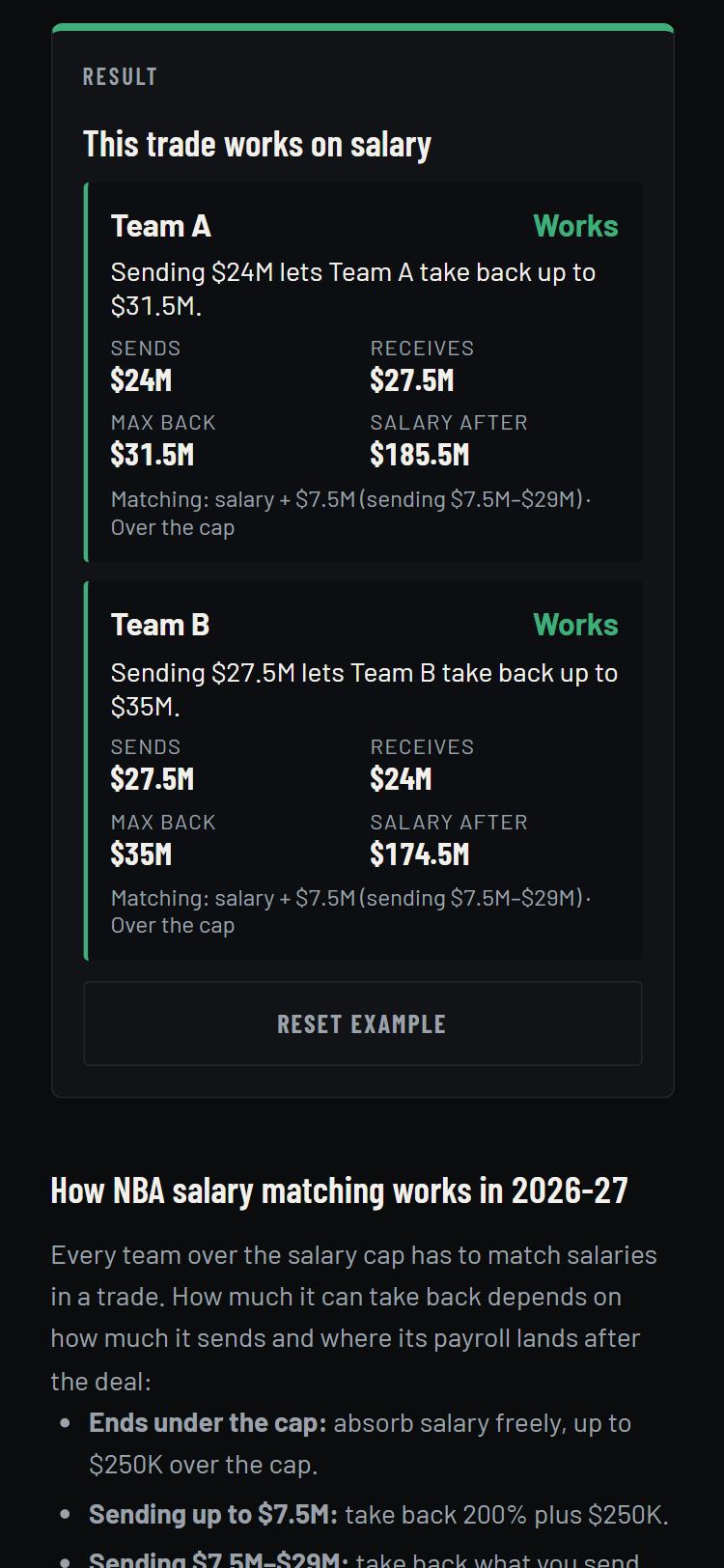
Want to test a real NBA deal? The free NBA trade checker applies the 2026-27 salary-matching and apron rules to any trade you can think of.
Trade demands are a deadline
Some players force your hand. A star who wants a ring will ask out of a losing team, and a Diva on your bench wants to start or leave. A trade demand is the worst time to sell, because everyone knows you have to move him. Read your locker room early and sell a year before the demand, not the week after. The player personalities guide explains who demands what.
Timing beats talent evaluation
The same trade is brilliant in November and desperate in April. Rules of timing:
- Sell veterans early in the season, when contenders still believe and the price reflects hope rather than scarcity panic discounts.
- Buy at the deadline only if you're truly one piece away. Half-measures at the deadline are how mediocre teams stay mediocre while paying premium prices.
- Sell a player one year early rather than one year late. Value falls off a cliff with age and contract length, and the cliff arrives before the stats announce it.
Reading your own timeline
Before every trade, classify your franchise honestly: contending, retooling, or rebuilding. Then apply the only test that matters: does this trade make us better in the years we plan to be good? A rebuilding team adding a 31-year-old is buying wins that don't matter. A contender hoarding picks is saving for a retirement it may not survive to see — your owner's patience is also an expiring asset.
Five trades to refuse on principle
- The star for parts. Three 70-rated players don't make one 90.
- The panic deadline rental that costs a first-round pick to upgrade your eighth man.
- The bad-contract swap with no sweetener — exchanging problems isn't progress.
- Trading a wide-range young prospect at his lowest point. If you drafted the upside, hold long enough to learn what you have.
- Any trade you'd accept "because the AI offered it." Unsolicited offers serve the sender's timeline. Read them for intelligence; accept them rarely.
The compounding mindset
Great GM careers aren't built on one heist — the AI here won't let you make one anyway. They're built on a dozen small positive-value trades that compound: surplus depth into picks, picks into prospects, prospects plus cap room into the star who tips a window open. Win each trade by a little, repeatedly, and the dynasty assembles itself.
FAQ
Can I fleece the AI like in other GM games?
Mostly no — lopsided offers get rejected or countered. The fun is that winning a negotiation actually means something.
Do AI teams protect their stars?
Yes. Franchise players move only when the situation justifies it, which keeps the league believable.
Is there a trade deadline?
Yes. The deadline arrives mid-season, and offers and prices shift as it approaches.
Do salaries have to match in trades?
Yes, for teams over the cap. Try the free NBA trade checker to see how much salary a team can take back.
Related: NBA trade checker · Salary cap guide · Player personalities · First season guide · Draft and scouting