Beginner's Guide: How to Survive Your First Season as GM
New GM? This beginner's guide to Basketball Dynasty covers your first roster review, lineup, trades, the draft, and how to avoid getting fired in year one.
Updated
Play freeYou've just taken over a franchise. The owner has expectations, the roster has problems, and the season starts whether you're ready or not. This guide walks through your first season in Basketball Dynasty — what to do in week one, what to ignore, and the mistakes that get rookie GMs fired.
Step 1: Read your owner before you read your roster
The single most important screen in your first five minutes is your owner's expectations. Everything you do this season is graded against it. A rebuilding owner who expects patience will tolerate losses but punish aimless mediocrity; an owner who expects the playoffs will not accept "we're developing the young guys." Your real job title is expectation manager — the roster is just the tool.
Step 2: Audit the roster honestly
Look at three things, in order:
- Age vs. ability. A 31-year-old star and a 24-year-old star are different assets entirely. One is a win-now piece losing value every season; the other is a foundation.
- Contracts. Find your worst contract — every roster has one. Big money for declining production is the anchor you'll be working around all year.
- The gap between your best five and the league. Be brutal. If your starting five wouldn't scare a playoff team, don't pretend a hot streak will fix it.
- Personalities. Every player has one or two traits. Note your Divas (they need to start), anyone who wants a ring (he won't stay patient through a rebuild) and your Mentors (keep them around young players). The player personalities guide covers all eight.
This audit tells you which of three modes you're in: contend, retool, or rebuild. Committing to one is the decision; trying to do all three at once is how franchises rot.
Step 3: Set your lineup and your game plan
Don't leave the rotation on autopilot. Pin your best players as starters, bench the veterans blocking your young talent (if you're rebuilding) or the projects who aren't ready (if you're contending). Small lineup edges compound across 82 games.
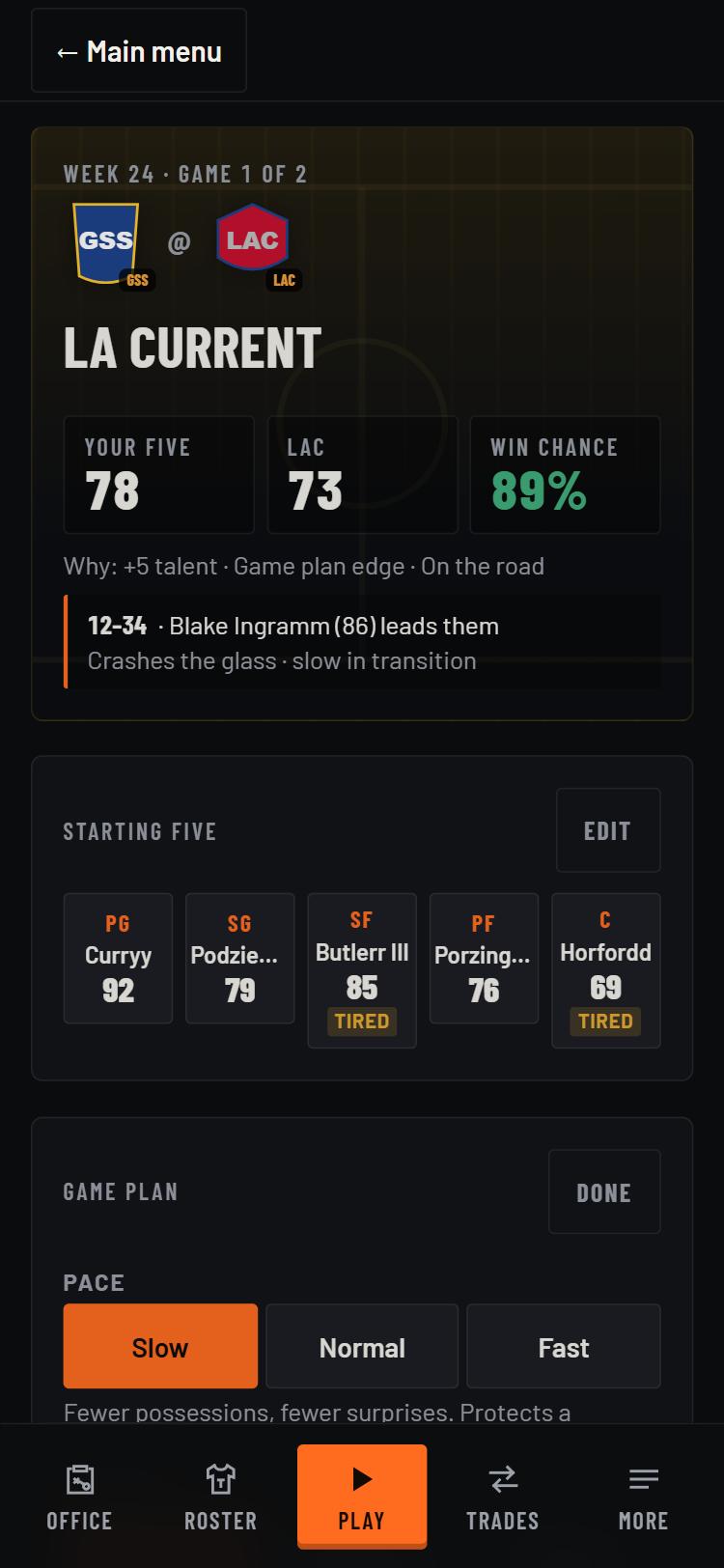
Then set a game plan. Game Day shows your win chance, the reasons behind it and a one-line scouting report on the opponent. Pick pace, offense, defense and rotation to attack their weakness, and watch the odds move before you play. Keep an eye on fatigue too: tired starters play worse and get hurt more, and the Rest tonight button exists for a reason. The game plan guide explains every option.
Step 4: Your first trade — and the trades to refuse
The trade AI in Basketball Dynasty negotiates like a real front office: it values its players honestly, protects its stars, and counters lopsided offers instead of folding. So stop hunting for the fleece — it mostly doesn't exist. Good first trades for a new GM:
- Sell the veteran who doesn't fit your timeline while his value is real. A 30-year-old scorer is worth more to a contender in November than at the deadline after an injury.
- Take back a bad contract to buy a draft pick. If you have cap room and patience, renting your cap space to a desperate team is the cleanest value in the game.
- Refuse the "star for parts" offer in year one. Three average players don't equal one great one. They never have.
When the AI counters your offer, read the counter — it's telling you what that front office actually values, which is intelligence you'll use all season.
Step 5: The draft — trust ranges, not certainty
Scouting in Basketball Dynasty is deliberately imperfect: you see a range of potential, not a true rating. That means busts and steals are both real. Three rules:
- A wide range on a young prospect is risk and upside — appropriate for rebuilding teams, dangerous for win-now teams.
- A narrow range is a known quantity. Contenders should prefer the safe 7th man over the lottery ticket.
- Never draft for need over talent in the lottery. Needs change in one trade; a missed star haunts you for a decade.
Step 6: Know what gets you fired
You don't get fired for losing. You get fired for missing expectations. A 28-win season on a rebuilding team with two promising rookies can be a success; a 44-win first-round exit on a team the owner expected to contend is how GMs clear out their desks. Before every major decision, ask one question: does this move the franchise toward what the owner was promised?
Your first-season checklist
- Read owner expectations before touching the roster
- Pick a mode: contend, retool, or rebuild — and commit
- Set the lineup manually and pick a game plan for each opponent
- Rest anyone who is Exhausted
- Make one trade that serves your timeline (and refuse the rest)
- Draft on talent and range, not roster need
- Check expectations again at midseason and adjust
FAQ
How long does a season take to play?
A season can be simmed in minutes or savored over hours — you control the pace, simulating day by day or jumping week to week between decisions.
Can I really get fired?
Yes. Miss your owner's expectations badly enough and you're out. That's the point — the game is a front-office career, not a sandbox.
Do I need to download anything or sign up?
No. It runs in your browser on desktop or mobile, and your save is stored on your device.
Related: Game plan guide · Player personalities · Trade strategy · Draft and scouting · Salary cap guide